


Music is the motor of 
 .
.
Strings are of the most beautiful instruments ever made.
A 

 finds inspiration and comfort in science and nature elements. Both elements are larger than a human being. It is always good to point at the mountain to see where you stand.
A list of might-have-been mentors of 
 :
:
Morton Feldman, Kairos, Bella Tar, Sergei Loznitsa, Alexander Cozens, Johannes Ockeghem, John Cage, David Attenborough, August Sander, Alexander von Humboldt, Aleksandar Hemon, Eugène Boudin, David Eagleman, J.D. Salinger, Monteverdi, Ray and Charles Eames, Georges Perec, Abbas Kiarostami and Daniel Johnston.
A 

 believes in the importance of rules.
He believes that the smaller the creation street of your workspace, the larger the creativity.
Don't try to create and analyze at the same time. They're different processes. This is a rule  borrows from Sister Corrita Kent.
A 

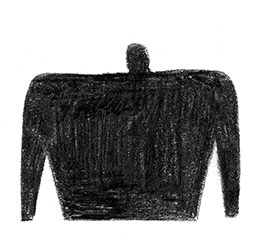 composer works like a painter. He or she uses only one subject to create the piece with. A digs deep: narrative along its horizontal line is less important than through its vertical line.
 musicians should stop playing the score, they should play the music.
For all musicians of 
 : the inside of the music makes the outside sound good. Monk once reflected on that matter, and so will we.


 uses real-life locations in nature as an inspiration for his compositions.
Musicians of 
 should be interested and open-minded towards the creator’s artistic ideas.
Musicians of  should play on mountain tops, swim in lakes, play chess or basketball.
A  always breaks rules.
A says: “In the detail lies the exceptionality!”, because here he finds comfort and hope.
make each other sound good. They use their imagination for every note they play. Every note is equal, always.
A listens to all sorts of music and all sorts of sounds. Sometimes he should even try to imitate them. He doesn’t like to judge too fast. He doesn't try to judge at all. He absorbs.
There are a few practical rules for musicians of (this list will get larger or smaller in the future):
A never ignores history. Better yet: he reflects on it. He looks at history as a flying brown owl upon his territory, seeking and reflecting.
A 
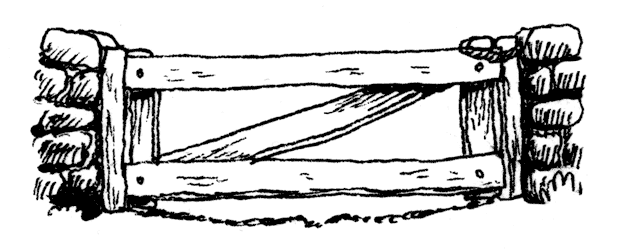
 wants to hop over fences and stride through tunnels to escape from the city via the land to the sea.
Music is a language without grammar.
A always questions his mentors. He remembers he is always free to turn his back on them — but only does so after long consideration, when the time is right. A won't make a personal fuss, and will go in peace.
considers everything an experiment. Music is a holy good, but the ‘creation experience’ can be lighter than you might imagine it.
Music is visual. Music is an image. Embrace the image.
A 
 composer writes from the land of utopia. The utopian dream is the most important stimulator. Realism needs to be reinvented on stage, location, concerts, film or graphic design.
Musically, favors baroque and renaissance music, 20th-century contemporary classical music, pop and electronic music. A thinks favorites should always change.
Excerpts from the One Trick Pony guidebook.